Tag: running

  • Treadmill Interval Workouts

    Have I mentioned several times already that I really like treadmill interval workouts? I wrote an article [HERE] in response to an article in Runner’s World recommending against doing treadmill interval workouts. Here’s a sample:

    They claim that in order to bail you need to push buttons, whereas on the track you just slow to a stop. Well, to make it apples to apples, I think you’d need to just stop moving your legs on the track to see what happens. Just kidding, don’t do that. When it comes to bailing, all you have to do is grab the handles and jump up on the frame. It takes a half of a second. – Stay Injury Free on the Treadmill (SevenSummitsBody on Blogger)

    I also discuss a few treadmill form tips and how to stay motivated and beat boredom if you want to go read that article.

    treadmill interval workouts on an Incline Treadmill
    Treadmill Interval Workouts on an Incline Treadmill at 5 AM while the family sleeps – 2013

    Back to Back Treadmill Interval Workouts

    That’s what I did today, March 27, 2014. First I got on the treadmill set at 3%, did about 15 minutes of warming up at up to about 4.5 MPH (MPH easier to use on treadmills than Pace). I did a test interval of a few minutes at 6.0 MPH followed by walking at 4.0 MPH. Keep in mind that my treadmill is at 9,400′ and that I’m 54 years old. My 100% HR (based on the 220-AGE formula) is 166 BPM. I did two Anaerobic Threshold workouts already this week [EXPLANATION] and one 75% zone workout. I am not recovered from those. That will explain a little bit about the numbers to come.

    After my warm-up and cool-down I did an interval of 6.0 MPH followed by 4 intervals at 6.6 MPH. I was using a very simple 1:00/1:00 pattern. A minute high and a minute low. I stayed low then for a few minutes, since I hit my 100% level and needed a short break. I prefer a bit of flexibility which is why I don’t program in an interval training session in the presets.

    I then did 3 intervals of (1:00 @ 6.8 / 2:00 @ 4.0). That’s one minute at 6.8 MPH and two minutes at 4.0 MPH. I walked most of the lower speed rests for these last three. At that point, my last glance at the treadmill was that I had gone just under 50:00, like 49:34 and 3.668 miles. I accidentally pulled the safety magnet off the console and it zero’ed out and stopped. Dang. I hate that. I need to superglue the magnet on. Drat. So I rounded it to 49:00 and 3.7 miles for my stats.

    I raised the deck on my NordicTrack Incline Treadmill to 32% and began walking at 2.0 MPH. Immediately I realized something was wrong and I was running at what I guessed was about 4.0 MPH. At 32% that’s running. Try it and see. Anyway, I checked the readout and it said I was going 2.0 MPH. I slowed it to 1.0 MPH but still was running at 4.0 MPH. I stopped it and continued running as the belt kept moving. Then I unplugged the treadmill to reboot. This happened before once. The controller forgets to add tension to the motor so it’s nearly freewheeling at a very steep angle.

    After the reboot everything was back to normal so after a too-long delay I got it up and running and began to walk on that steep incline at 2.0 MPH. Averaging 2.0 MPH at 32% is approximately 1000 VAM. My primary goal right now is Elbrus Race 2014 so working the VAM is essential to my training. [CLICK HERE] for an explanation if you’d like to know more.

    After 9:00 @ 2.0 I did 1:00 @ 1.0 MPH. That’s a very long interval, but when I’m on a mountain I like going for as smooth and long of a pace that I can. Then I did 6:00 @ 2.0 / 1:00 @ 1.0 MPH. Getting a little shorter there but I was feeling pretty beat from my previous running interval. Finally I did 5:00 @ 2.0 / 2:00 @ 1.0 to finish. It felt good. One of my secondary goals was to get as close to 1000 VAM as possible. That’s why I was doing the really long intervals at 2.0 MPH.

    I hung out for a bit cleaning up before I turned off my Suunto Ambit2 S Heart Rate Monitor and plugged it in for the stats. I spent quite a bit of time just under my 100% Heart Rate Zone. Do not do this! Unless of course you know for sure you can. The 200-AGE formula is just a starting point for average cardio training people to start with. When I’m rested I can spend time at 110%. I am guessing my actual Anaerobic Threshold to be around 166. I will get the blood test sometime but it’s much more difficult than it needs to be in CO. In UT it was a piece of cake and I didn’t take advantage of it while I was there. Maybe on a business trip…

    Back to Back Treadmill Interval Workouts - stats on Movescount
    Back to Back Treadmill Interval Workouts – stats on Movescount

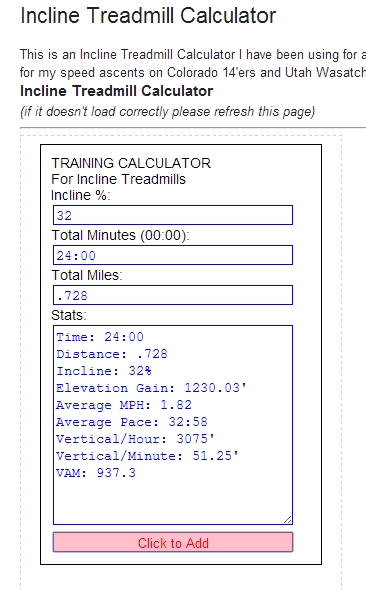
    I used my Incline Treadmill Calculator [HERE] to get my stats from the back to back treadmill interval workouts.

    Treadmill Interval Workouts March 27 #1:

    Time: 49:00
    Distance: 3.7
    Incline: 3%
    Elevation Gain: 586.08'
    Average MPH: 4.531
    Average Pace: 13:15
    Vertical/Hour: 718'
    Vertical/Minute: 11.96'
    VAM: 218.7

    Treadmill Interval Workouts March 27 #2:

    Time: 24:00
    Distance: .728
    Incline: 32%
    Elevation Gain: 1230.03'
    Average MPH: 1.82
    Average Pace: 32:58
    Vertical/Hour: 3075'
    Vertical/Minute: 51.25'
    VAM: 937.3

    Treadmill Interval Workouts for You?

    So now that I gave you all of this information about my own treadmill interval workouts, how does it relate to you? What information can you get from my examples?

    • Warm Up and Cool Down Sufficiently
    • Be ready to change gears in a heartbeat if needed
    • Get enough rest in the lower speed phases of your intervals
    • Mix it up with different inclinations and speeds
    • Set targets and goals that apply to your larger goals
    • Do a variety of training protocols over the weeks
    • Be sure to keep your eyes open to the big picture

    I’ve been doing different types of treadmill interval workouts depending on my current goals, on what altitude I’m at, and what kind of treadmill I’m on. It also depends on what my previous workouts were that week as well as what workouts are coming up in the next week.

    Don’t be afraid of these workouts. They’re as easy or difficult as you want to make them. Start out slow and work your way up. Remember that most of the running information you find on the internet, deep down inside, is meant for people running 7:30 miles. If that doesn’t apply to you then sort through it and find what you need and make it work for you.

    If you have any questions, comment here or on my Facebook page. I’m happy to offer little suggestions or advice, and if you subscribe to the blog (little box to the upper right) you’ll get notices whenever I post a new article here.

    Interval Training is perfect for the stop and go nature of rock climbing
    Interval Training is perfect for the stop and go nature of rock climbing
  • Training Log: Bonneville Shoreline Trail 12 Nov 2013

    Last night I went to bed with a crazy idea. To do a 5K PR on the BST, or Bonneville Shoreline Trail. Along the Wasatch Front of Utah we just call it the BST for simplicity. Everyone who runs or bikes knows it. Here in Utah County it’s pretty dry and barren for the most part. It’s made up of various jeep roads along the base of Mount Timpanogos here in the Northern part of the County. Further South it has a few more trees on it, down by Rock Canyon.

    Just after completing my 5K PR on the BST
    Just after completing my 5K PR on the BST

    I parked at a church near the Cedar Hills Golf Club, since they don’t mind much and the paved rec path is there to access the dirt road. I walked about a quarter mile to warm up, then hit the button on Strava [results] and my Watch. I monitored my progress closely, with the Pace View on the watch to make sure I stayed below a 10:00 pace, with a target of 32:00 minutes for my PR.

    There were a few steep but short hills and a few longer gentler uphill grades, and I had to walk a few times. Then at 1.6 miles I turned around and gave it a little more speed. My legs and lungs were sore and I came in at the starting line, about 3.2 miles and then tapered to a walk to let my heart rate decrease. When I uploaded the run to Strava it did in fact meet my goal at 31:25 for the 5K PR.

    Later I looked at my Polar results and my heart rate was over 160 for almost the entire return 1.6 miles. Awesome job, if I do say so myself. Below is the GPS track from Strava and then a gallery of some of my results graphs from Strava and Polar.

    [map style=”width: auto; height:500px; margin:20px 0px 20px 0px; border: 1px solid black;” gpx=”http://fps.dzl.mybluehost.me/website_031b6ccf/blog/wp-content/uploads/BST PG 5k 12 November 2013.gpx”]

    Map and Splits
    Map and Splits
    Pace Overview - Elevation and Pace
    Pace Overview – Elevation and Pace
    Pace Analysis - Splits
    Pace Analysis – Splits
    Pace Analysis - Smoothed
    Pace Analysis – Smoothed
    Pace Distribution based on Tempo
    Pace Distribution based on Tempo
    Polar Heart Rate (in the red zone)
    Polar Heart Rate (in the red zone)
    Polar Heart Rate Zone Displayed
    Polar Heart Rate Zone Displayed
  • Video Collection: Training in Colorado

    I’ve been in Colorado most of the past month, and training for Elbrus Race has been my primary goal. I’ve had to adjust slowly to the training effect from being above 9,000′ for all of my training. That’s good for me. I hope.

    I’ve been doing strength training at the Breckenridge Recreation Center.

    http://instagram.com/p/a_HXS9qxbz/

    I’ve been trail running, as in this clip from Keystone Gulch Road.

    http://instagram.com/p/a3dVJ6Kxeb/

    Especially on steep trails, like Mount Royal overlooking Frisco, Colorado.

    http://instagram.com/p/a00HiDKxTc/

    And I’ve been to the top of Quandary, a Colorado 14’er, a couple of times.

    http://instagram.com/p/a8vhHMqxWG/

    I’m having a blast, and watching my fitness improve almost daily. I’m hoping to do great at the Elbrus Race 2013.

  • Trail Running Fartlek Training

    I went out this morning for some winter trail running. My goal for the current program was 4.2 miles. I figured I’d be able to crank that out even with some uphill walking in less than an hour depending on snow conditions. I started at a local pool parking lot, like usual. I had done some ice climbing the day before which required a mile approach with over 500′ of elevation gain hiking up a steep gully of rock and ice. I wasn’t sure how that would affect my trail running, so I was ready to just jog lightly if needed.

    Spiked Trail Running Shoes
    Spiked Trail Running Shoes: Hoka One One Mafate WP with screws

    The first part of the road was slick ice over the surface. I was glad to be wearing my spiked trail running shoes [article]. They stuck to the ice and I didn’t feel at risk of falling at all. I ran to the gate, and through. The road surface was pretty icy for the first half mile, with long strips of ice-impregnated dirt showing through. My shoes stuck well. I was glad to be wearing them.

    Trail Running in Keystone Colorado
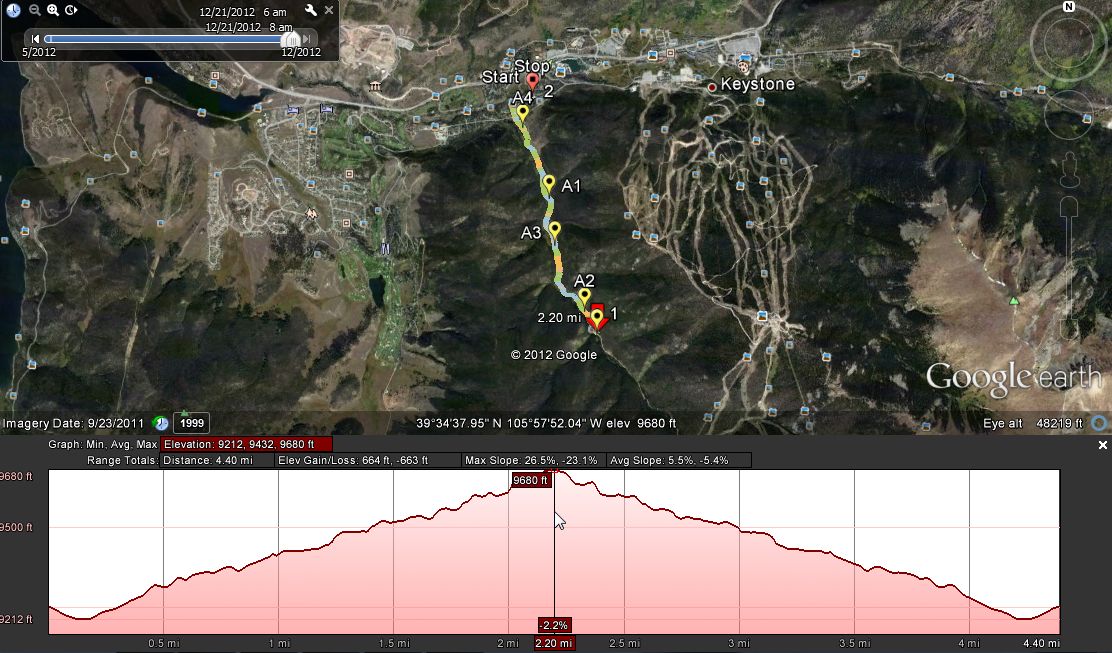
    Trail running up Keystone Gulch Road behind Keystone Ski Resort in Colorado

    I actually felt really good. I did intervals up the road, choosing somewhat random targets. I ran to a fence post, or a stick along the shoulder, or a mottled shadow. Since you’re not at a track, trail running intervals don’t need to be structured as exact distances or times. This type of random-ish unstructured interval is called “Fartlek”.

    Trail Running Fartlek

    Fartlek, which means “speed play” in Swedish, is a training method that blends continuous training with interval training. The variable intensity and continuous nature of the exercise places stress on both the aerobic and anaerobic systems. It differs from traditional interval training in that it is unstructured; intensity and/or speed varies, as the athlete wishes. Most fartlek sessions last a minimum of 45 minutes and can vary from aerobic walking to anaerobic sprinting. Fartlek training is generally associated with running, but can include almost any kind of exercise. From Wiki

    I ran out 2.1 miles, my half-way point and rested for a minute and took some pictures. I started down, and felt like I was flying. I did a somewhat long trail running interval, and walked down till my heart rate was below 130, then took off flying again. Usually in winter trail running I slog along and just enjoy the scenery. I again set my distance target to various appealing looking sticks or trees or shadows or rocks. It was a struggle to get there sometimes, but it’s great mental discipline.

    Trail Running at Keystone Gulch Road
    Trail running turnaround point at 2.1 miles surrounded by snowcat tracks

    I continued my trail running intervals to my “targets” and walking till my heart rate descended below 130 till I got to the gate. There were a couple guys skinning-up their skis, and someone walking a big dog. I walked past them so I wouldn’t scare them. My heart rate got below 120 for a couple minutes. I took off again on the ice-covered road to the parking area. I felt great. Since I set my new goal to do the Uber Rock 50k trail run in Vail this coming September I’ve adjusted my training program into something like “40 weeks to an ultra”. Trail running 30 miles up and down the mountains between Vail and Minturn will require that I be in the best of shape for it. I learned that in Aspen Backcountry Marathon in 2011. I survived. That about sums it up.

    trail running stats on a gps hrm watch
    Stats from my Polar RS800cx

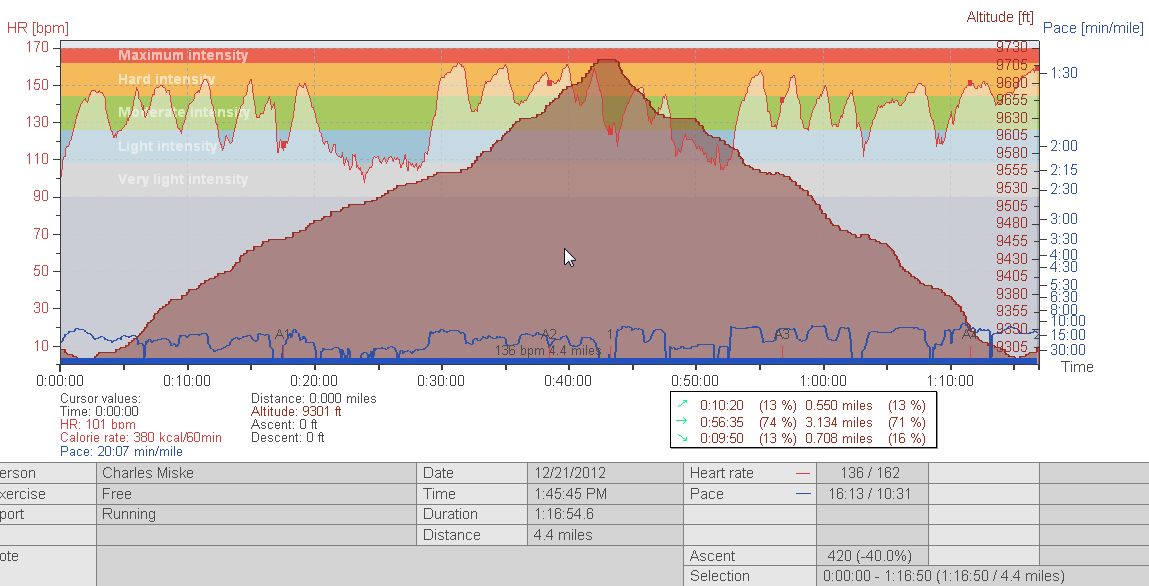
    Above is the result of my winter trail running fartlek session, via my Polar RS800CX GPS G5 Heart Rate Monitor. Oddly the intervals are mostly fairly regular. I didn’t do that intentionally. According to the Google Earth elevation profile I did 560′ up and down. I take into account stats from both Polar and Google. One is based on atmospheric pressure, the other on waypoint interpretation.

    The temperature was about 15 degrees F, but in the sun it felt warm and in the shade cool. For winter trail running you have to dress for both the fast and slow portions of your run. You should feel a little bit warm while fast, and a little cool while slow. I had dressed for a slow trail running session, so I was really warm during the speed intervals. It was a bit too cool to unzip during them though. If you choose to go trail running in the winter, please be careful, dress appropriately to your own metabolism and running goals, and consider wearing spiked shoes or some detachable traction device.

  • Trail Running in Winter at Keystone

    Trail running in the winter can be exhilarating and quite an adventure. It’s one of my favorite activities. I love to run in the Winter in Keystone Colorado at 9300′ or more in elevation. One of my favorite trails to run on is the Keystone Gulch Road. This is the access for snowcats and snowmobiles to the back lifts of Keystone Resort. Normally the road is packed down by the constant daily snowmobile traffic, so it’s easy enough to run in spiked shoes. I had done Gray’s Peak with a friend on Saturday December 29 on a very cold day. My Polar Graph showed that I should have about five days of rest. Today, January 1 was a whole new year, right? I decided a mild bout of winter trail running should be fine.

    Trail Running in Winter clothing and gear
    Trail Running Winter Clothes and Gear

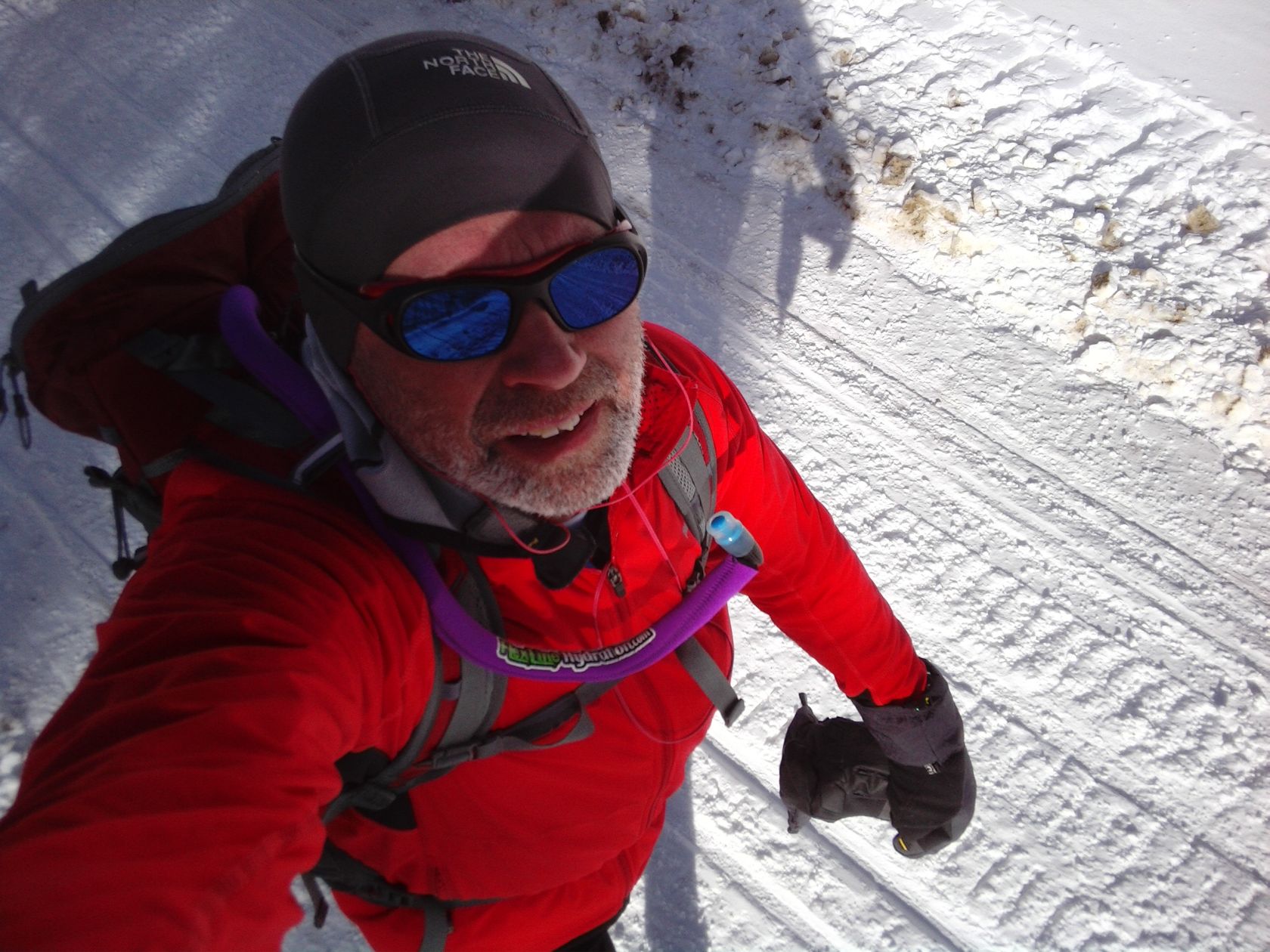
    Trail running this winter morning would be probably the coldest I’ve done. When I started it was zero degrees Fahrenheit out. That’s cold. I’ve run at 5 degrees before. I’ve done the 14ers at below zero. Then you’re moving a lot slower and can wear and carry more emergency gear. I decided on my new Sporthill pants, which did pretty good at 5 degrees the other day. I decided against base layers. I wore a Patagonia fleece hoodie as my next-to-skin layer. Experimenting. I wore a thin waffled fleece over that, then a thin wind shell with breathable panels. I wore my classic favorite TNF running beanie on my head. I’ve grown to like my Injinji liners and Smartwool Men’s PhD Mountaineer Crewsocks as cold weather running footwear. For my hands I decided to experiment with my Burton touch-screen liners under my REI Winter Biking Lobster gloves.

    Trail Running on Keystone Gulch Road

    Trail Running in the Cold behind Keystone Resort
    Trail Running in the Cold behind Keystone Resort

    I started my HRM/GPS watch in a parking lot near the entrance to Keystone Gulch Road. The road can be pretty bumpy and has space for only a few cars. Warning: park at your own risk wherever you decide to park since most of this is resort property. I walked quickly up the road swinging my trekking poles, Black Diamond Compactor Ski Poles. Today my goal is to run/walk intervals working on improving my turnover rate (foot strike speed) by making smaller faster steps. I also am going to work on syncing my pole swing with my steps to increase the number of steps per pole swing.

    At the gate, just up the road a short bit, I tapped my lap counter and took off running slowly uphill. I worked my way up the Gulch Road with what I interpreted as fairly even run/walk intervals. After a while I decided to do some trail running hill repeats on a particularly pleasant grade. Usually you run up and walk down, or walk up and run down, depending on your training goals. Today I’m running down, quick turnaround then up. I paused at the top for a minute to catch my breath, then repeated it.

    Trail Running Hill Repeats in Winter with Poles: Video

    When I was done I gathered up my camera and took off trail running in the snow uphill again. The sun was pretty, and the wind was light. Bright flashing crystals of snow blew off the pine trees. I kept up the run/walk intervals for about an hour of total time.

    Trail running in winter along the Keystone Resort back side
    Making snow at Keystone Resort on North Peak

    I had hoped to get to the base of North Peak, near the LaBonte’s Cabin area. I’ve been there a few times for trail running on this road. It’s about three miles from the gate. Today my face was getting really cold and I decided three miles from the parking lot was a good enough turnaround point. I was using my backpack for training and to carry water. I was using my Flexline Hydration system with a Platypus Bladder inside the insulated sleeve of my Marmot Kompressor backpack. I also have my GoLite Bitterroot down jacket for just in case. Smart when it’s at zero degrees.

    winter trail running on the snowcat tracks at keystone
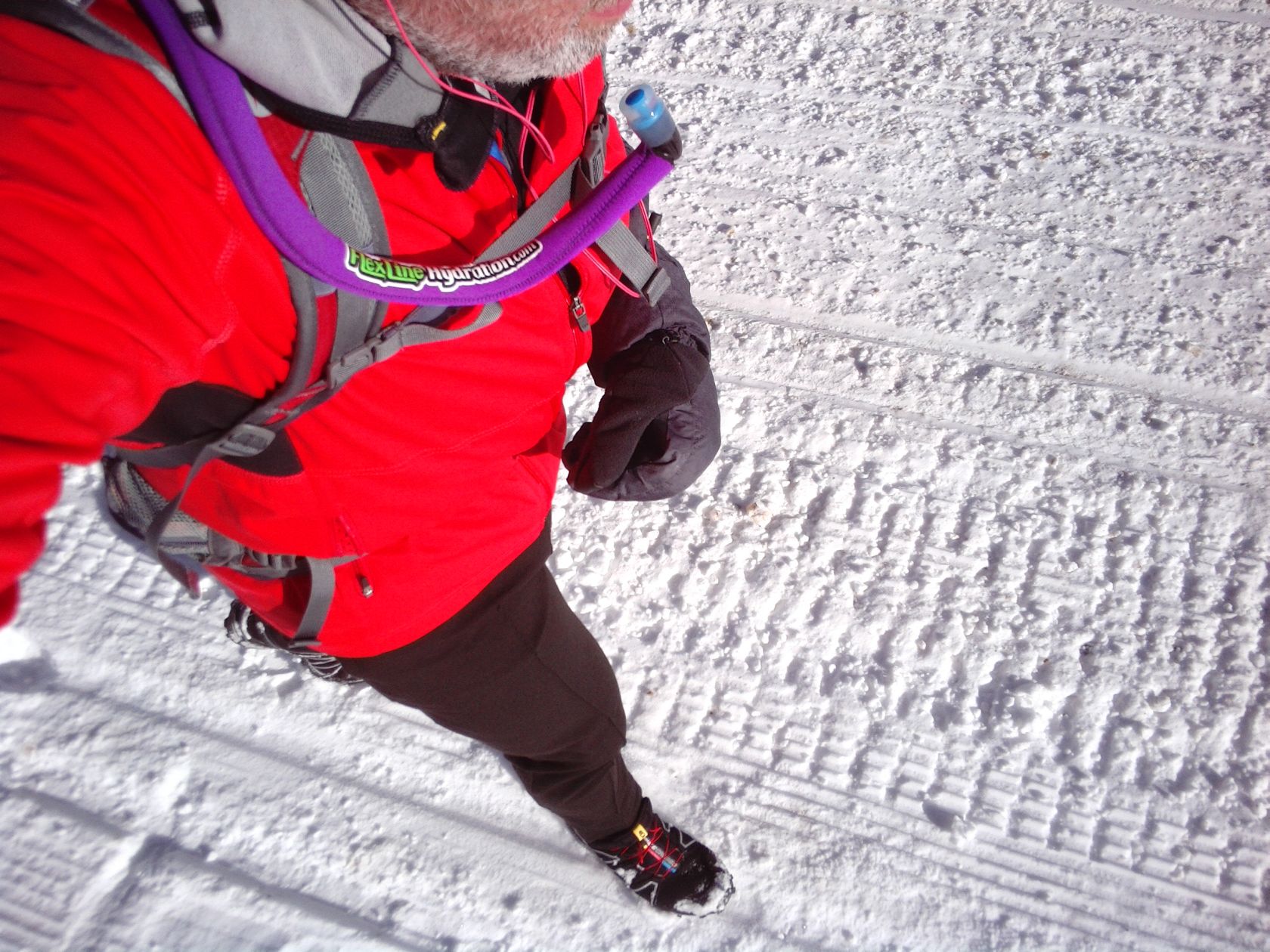
    View looking down on myself and the snowcat tracks I ran on

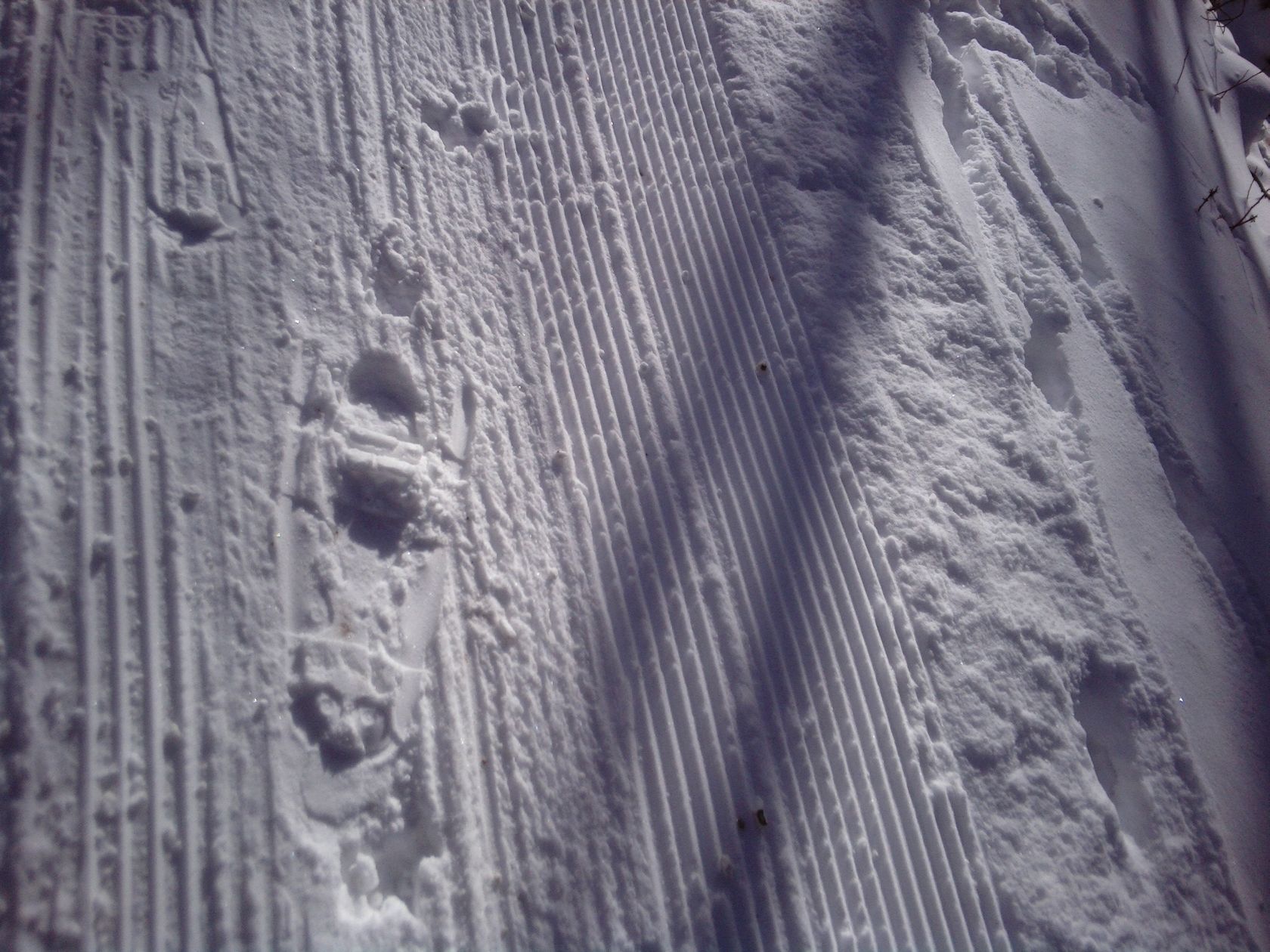
    On the way downhill I worked to stay around an 11:00 minute mile pace. The footing was rough, between the tracks of a snowcat and multiple snowmobiles passing up and down the road all day. It varied with ice chunks, chopped snow, ice sheets, and narrow gullies between the paths. I can sustain an 8:20 pace on nice dirt trails, but chunky snow is totally a different trail running surface. I had to take a couple of walking intervals but tried to keep them short, drinking from the Flexline tube at each one to stay hydrated. Since the whole run would be less than two hours it wasn’t worth eating. YMMV. Remember that one key to success in using a bladder system at this cold a temperature is to totally blow all the water out of your tube between each drinking session. Short frequent drinks are better than longer drinks at longer intervals. If ice does start to build up you will suck it out of the tube more often and keep it clear with more frequent drinking.

    One of my favorite trail running roads at Keystone Resort
    Looking down the road at Keystone Gulch behind Keystone Resort

    As I got further and further along I had to take more frequent and longer walking breaks. I finally got to the gate and hit my lap counter again to mark it. I ran quite fast down the road, crossing the street carefully, then walked to cool down to the parking lot. My face felt pretty windburned, and when I got home my nose hurt quite a bit when it thawed out. I recommend sealing your nostril skin surface with chapstick when you go out in this level of cold. I will do that next time for sure.

    Winter Trail Running: My Stats

    I checked the stats on my Polar RS800CX and found that I had spaced out my intervals pretty decently. I had maintained a good pace, especially on the way downhill. I also looked at my heart rate zones and found a good spread, pretty full in the upper middle, where I want it right now. It was a good way to train my last day in Colorado for this trip.

    trail running polar graph with elevation, heart rate, and pace
    My Polar Graph with elevation, heart rate, and pace from my trail running adventure

    If you decide to try trail running in the Winter, I highly recommend you break into it slowly. If you’ve never run outside before, or on uneven surfaces, it might not be a good idea. It’s going to be cold, and if it’s windy, miserable for most people. Wear the appropriate clothing, and try to avoid sweating if you can. It’s best to be slightly cool rather than slightly hot.

    Winter Trail Running heart rate distribution graph courtesy of Polar
    Polar heart rate zone distribution for this winter trail running adventure

    Above all, stay safe, stay warm, and remember that trail running below freezing can be fun 🙂

  • Winter Trail Running in Colorado

    Winter Trail Running is one of my favorite training routines. I love the cold air. I love the snow underfoot. It’s much softer than running on pavement. This morning it was 2 degrees F in Keystone Colorado. I had some other things to do, or I would have run first thing in the morning.

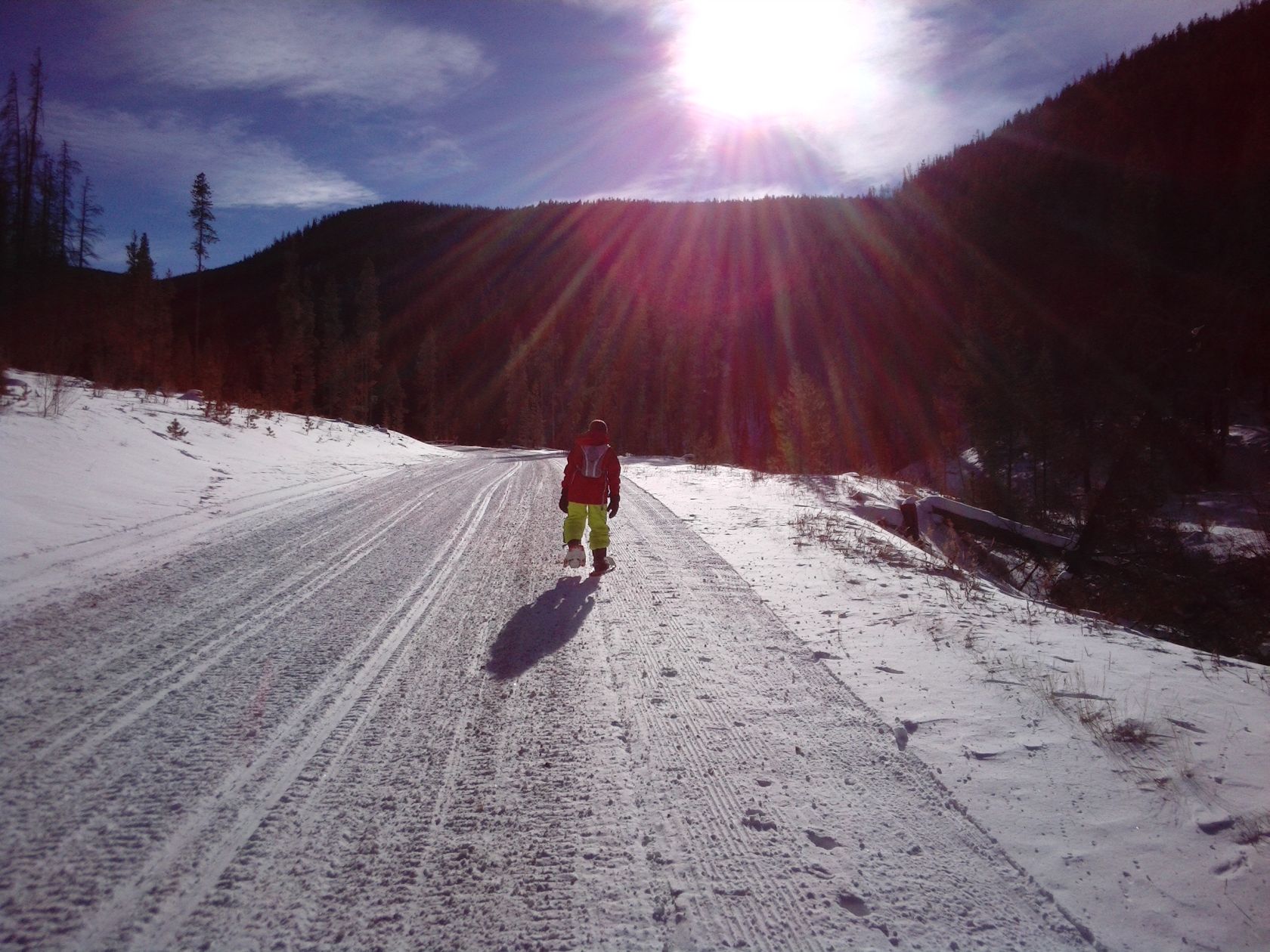
    My 12 year old son wasn’t up for Winter Trail Running, but decided to go snowshoeing instead. I gave him a little head start. After a while I started up the road behind Keystone Resort in Colorado. The Ski Patrol uses this road to haul injured skiers down to meet the ambulance. Sure enough at the gate to the road an ambulance waited. About a quarter mile up the road I stepped to the side to allow the snowmobile to pass. There was an injured skier in the sled, with red and blue lights flashing.

    For Winter Trail Running you have to experiment a lot with clothing and shoes. I try to dress as lightly as possible. This afternoon it’s about 15 degrees, but the sun will be going behind the ridge soon and the temperature will drop. I’ll also spend some time walking with my son. My plan is to run and walk in intervals. The Polar Graph shows my intervals best in the heart rate zone lines.

    For my Winter Trail Running, actually any trail running, I like to wear my Polar RS800CX GPS G5 Heart Rate Monitor. I like the graphing functions in Polar ProTrainer, and export the data to Google Earth so I can see it from a very different angle. Using the Polar WebLink software I can upload my data to PolarPersonalTrainer.com but that’s very clunky. I only do that to add my Training Load data. That way I can plan my intensity of training for the next few days to ensure proper recovery.

    Winter Trail Running Clothing

    Today for winter trail running I wore a thin long sleeve training tee as a baselayer. Over that I wore a thin zipper hoodie. For my outer layer I wore a windproof winter training jacket. I wore a thin beanie from TNF, and in the shadow of the setting sun, I flipped the hood up. For gloves I wore a pair of REI winter cycling gloves with the lobster configuration, since my hands were a bit cold last year in my fleece gloves.

    My lower body winter trail running choice was a single layer loose winter tight by Sporthill. I’ve never worn it before so it was a bit risky. It felt just a little warm in the sun, and just perfect in the shadows. On my feet I wore a pair of Injinji liners under a pair of Smartwool PHD thick mountaineering socks. They fit just perfect in the Salomon Men’s Spikecross 3 CS Winter Trail Running Shoes. I wore these on my hike up Quandary last winter. They have sharp square rubber lugs on the sole and steel spikes that stick in the ice. Tip: don’t put them on and walk on your tile or carpet if you can help it. They’re also noisy on asphalt.

    Everything worked fine. I did sweat a little bit, and it got chilled a lot during those times I walked with my son. As soon as I started moving I warmed up again quickly, so I think it was a good balance. The shoes worked good, and my feet were never cold. These are very thick socks though. One thing I noticed is that these shoes do have a bit of a heel, and it’s very stiff. If you’re used to flatter, or more cushioned shoes it will take a bit of effort to stay forward on your toes. Especially on the downhills.