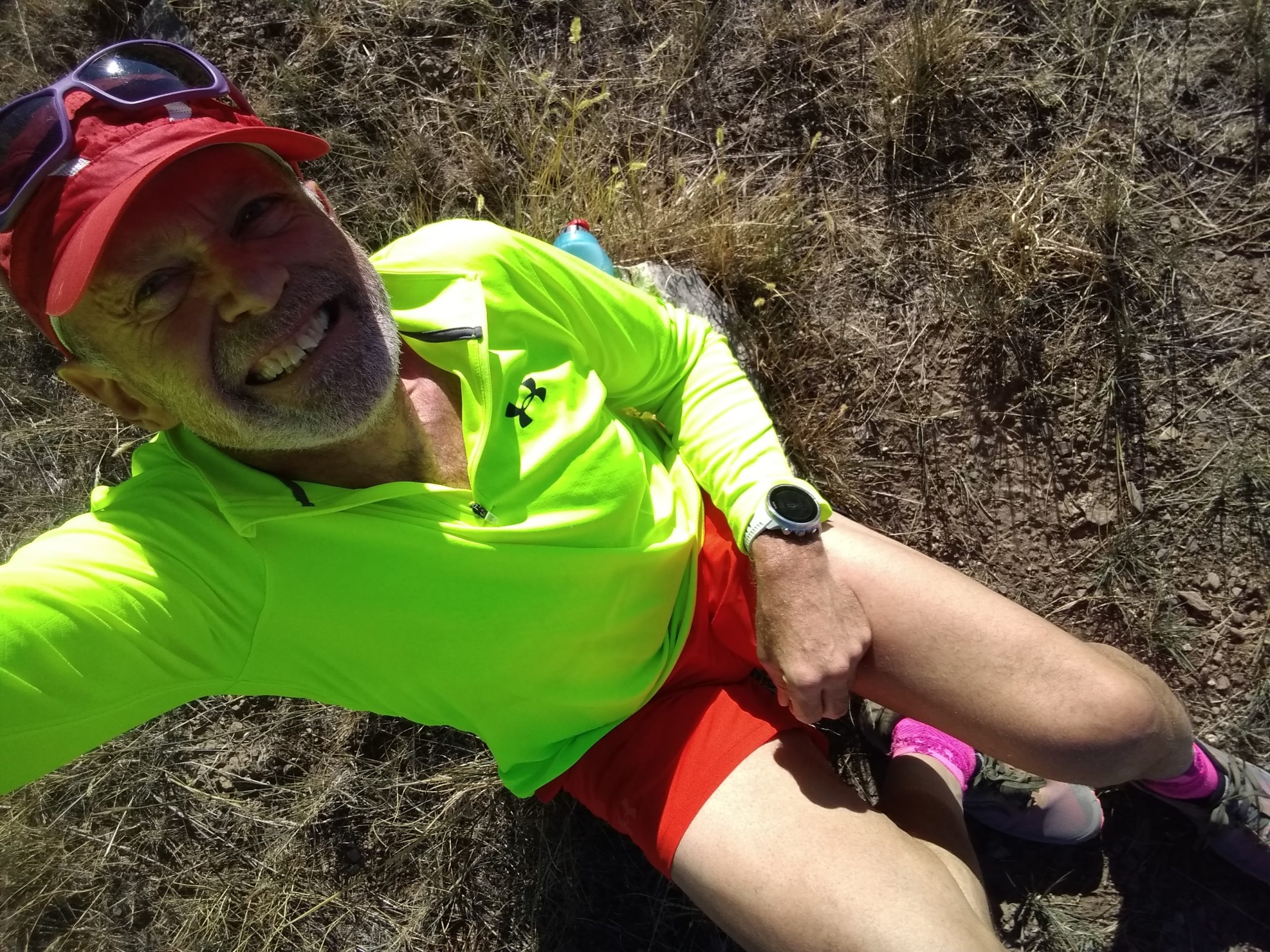
Of all the crazy things to do, with only a handful of days to go, I ended up with new shoes. I have been having trouble with my feet for a couple months now, from nearly-blistered hotspots to plantar fasciitis, to bleeding scrapes from the shoe itself. My Topo Athletic Ultraventure Pro (?) died a horrible death, and only about 100-ish miles into it. The plastic toe cap liner (protects from rocks) delaminated, and the edges curled under cutting my toes on the descent. I was going to wear them too. I took them in to where I bought them, Runners Corner in Orem, and the girl who ended up having to put her magazine down didn’t want to help, said there was no such thing as delamination, and wanted to know if there was something I wanted to buy. I declined much more gracefully than I would have liked to.
With only a week to go, I got talked into going in to Utah Run in American Fork. I have gotten a few pairs of shoes there, and appreciate the more inclusive and open-minded employees there. Hope we didn’t just jinx them. I ended up with a pair of Saucony Peregrine 11, which have sufficient curvature for my wacked feet, and tread that reminds me a bit of my old Salomon Crossmax I used to run in way back before Hoka.
My own taper program, derived from modeling 2019 (Broken Arrow VK, at which I felt really strong) I had a couple miles on the treadmill with a few quick intervals/strides in store, so I did that on Friday in the new Peregrine, and the new Ultra Spire handheld as an experiment. It went pretty well, but I didn’t quite hit my target TSS from Training Peaks.
This morning, Saturday, I decided to run/walk/jog on one of my favorite trails nearby, Green Monster, a Strava route just a few miles away. I parked at the Murdock Canal parking and headed up Giddy-Up, a “hoof and boot” trail (meaning no mountain bikes, though there is a guerilla bike park about a quarter mile up it for the local kids in the hood), forked on the “Bench Road” (which is actually the BST-enough) and then up Green Monster for two laps. I did some sustained effort at 2500’/hr vertical, some intervals of strong power hiking at 3600’/hr and on the flatter sections, some intervals at 9:00 pace. On the return to the car I sustained a half mile-ish at 12:00 or less just to burn out the fat.
Next time, let’s talk about the “Almost but not quite VK” next Friday, setting up HR zones in all the apps and stuff, and maybe some more fun things.
The NiteRider TL 5.0 SL tail light. Long name, simple light. It’s got a few flashy settings to make sure you are visible to vehicles. I got it to replace my 20 year old tail light that finally disintegrated. Here it is, fresh out of the box. I’m going to use it first for running in the pre-dawn darkness on the highways and rec paths of Utah County.
Today was a great day for a trail run. I went trailrunning this morning at -1F (according to the weather channel). Accuweather had it at -13.
Nothing like a little negative F to kick off the morning trail running
I went out on the deck and it felt more like the weather channel had it at -1F so I dressed for that. It was snowing pretty hard and there was at least 8″ of new snow on the ground. I wore a minimum of clothing, in spite of the cold. It’s better to be slightly cold and dry, rather than dressed really warmly but sweat too much. That sweat will chill you if the wind hits it.
Dressed lightly for a winter trail run at -1F
I wore my Pearl Izumi Trail N2 with Kahtoola microspikes. I’m glad I did. The trail was really bumpy with icy spots under the powder snow. You couldn’t see under the snow so it was good to have the extra spike aggressiveness. I had thought of wearing my Hoka Stinson with the screws in the bottom.
Winter Trailrunning Video on Vimeo:
[weaver_vimeo id=”111698274″]
I wore Salomon hybrid top and bottom. When I say hybrid I mean a thin athletic fleece with wind and water resistant panels. I wore the loose tights without a base layer. On top I had on an Arctyrex mid-weight base layer. That’s it for clothing. For socks I wore thick wool mountaineering socks. For gloves I had on bike commuter lobster mitts from REI for my hands. On my head I wore a buff, a mid-weight helmet liner, and a swag Salomon baseball cap I got at a race.
The snow was light and fluffy and dry so I didn’t really need to worry about my feet getting wet. When I turned around at the 2.5 mile mark the wind was pretty cold on my chest. I had a thin insulated vest in the UD Pack, but in a few minutes I was warm again so it was worth waiting before I got it out. It ended up I didn’t need it.
Why would anyone consider treadmill training for hills?
Here are some of my favorite reasons:
Recovery from injury
Meeting specific goals
Controlled environment
Weather
Time
Local terrain
Let me take a few minutes to examine each of these reasons or excuses for treadmill training for hills.
First of all is recovery from injury. I myself am currently in this group. About a month ago I went for a hike with some 18-20 year old guys I know, and we ascended Mount Royal in Frisco CO. It was fun, but then they all decided to run down and I, like an old man in denial, decided to keep up with them. I did set a PR, but part of that is that I rarely run down, deciding instead (wisely) to preserve my knees.
Hiking group at the saddle on Mount Royal in Frisco, CO
So now, yeah, my knees are thrashed. I took a few weeks off, tried to get back into running, but the trails I can get to easily are all up and down, and the downhill was killing me. My knees would never recover on those trails, so I’ll be doing some treadmill training for hills.
Why? The steady incline allows me to set vertical goals without having to endure the descent. This will allow me to maintain some mileage while giving my knees a chance to heal.
Second advantage to treadmill training for hills is that it facilitates meeting specific goals. If you have a goal that includes speeds, or elevation gains, or heart rate, it’s a lot easier to measure, monitor, and track on a treadmill. Need to go 3.0 miles at 5%? Just set it and forget it on the treadmill.
Anaerobic Threshold Training setup with Suunto Ambit 2S on the handle of the treadmill
If your goal also includes a heart rate, such as with Anaerobic Threshold Training ARTICLE HERE you can set the watch up in view and then adjust your speed up and down to maintain your heart rate in the prescribed zone. That’s a lot harder to do outside.
Third, it’s a controlled environment. You can wear whatever you want, the incline can be as steady or varied as you want, the speed can be anything you want. There is a bathroom just down the hall. You can refill your water or supplement bottles all you want.
Fourth, is weather. Treadmill training for hills avoids a lot of the complications of the weather and time. When it comes right down to it, if you want to practice being completely and totally soaked and frozen, with sheets of ice on your pants, then it’s probably a lot of fun to go do that outside. But you can’t promise that you will be able to maintain your pace, distance, heart rate, or any of your other goals while struggling for survival.
Winter Trail Running Salomon Spikecross on snowcat tracks
Fifth is time. This is a big deal for a lot of people. Sometimes that awesome hill climb route is an hour or more away, You can’t really justify taking that much time out of your day when there is a treadmill in your own home, your own apartment complex, or the gym on the way to work.
Sixth, is local terrain. There are a lot of people who have contacted me with the sad fact that there are no hills in their area. There is a lot to be said for running 5 miles at 6% incline. You can’t really duplicate that experience with stadium running, which really does use very different muscles. For hiking that would be great, but not for running. Some people advocate hill repeats on a 50′ hill, if you have access to one. That might work great for sprint training, but it doesn’t quite duplicate that same type of endurance that 5 miles at 6% does. Treadmill training for hills solves that problem in a very handy, easy to find, easy to use method.
How to use treadmill training for hills
Vertical training protocols are the main focus of my book “Summit Success: Training for Hiking, Mountaineering, and Peak Bagging” and I really suggest you get one if you’re serious about planning a program around vertical goals. It takes you from “the couch” to nearly 4,000′ of vertical per week over a 16 week period, which I feel is a worthy goal for most anyone who is not used to hills.
Treadmill training for hills helped me ascend Orizaba quickly
While the book is specific to hiking, the goal charts include vertical and horizontal goals that you can also achieve through increasing the speed on the treadmill while running on it. That also means you can spend less time on the treadmill, since you’ll be moving twice or more as fast. In my own training I use a similar set of protocols.
Here is a sample of a treadmill training chart as used in the manual, adjusted for 4% inclination, rather than the goal incline of 15% used for hiking:
Week
5
6
7
8
Target Weekly Vertical Ft
1,130
1,255
1,395
1,550
Weekly Miles at 4%
5.349
5.943
6.604
7.338
Incline Miles Per Session (x4)
1.337
1.486
1.651
1.834
As you can see, if you’re a runner it’s really easy to get these miles in every week. If you’re a beginning runner it shouldn’t be too hard either.
I wanted to introduce you to the idea of treadmill training for hills, and give you a few of the best reasons for doing it. I also wanted to show you an example training goal chart, modified for running from my training manual.
In an upcoming article I will explain how to adjust all the charts in the manual for running, rather than hiking, and talk a little bit about using VAM for training goals.
VAM is the abbreviation for the Italian term velocità ascensionale media, translated in English to mean “average ascent speed” or “mean ascent velocity”, but usually referred to as VAM. — WIKI
Thanks, and let me know if there are any questions or things I did not explain adequately.
Here’s the Farmers Carry Workout I’ve developed over the last few weeks. It’s good for my trail running and hiking and I’m sure it would be worth your while to watch the short video for my own variation on a Farmers Carry Workout, posted to my youtube channel.
With this Farmers Carry Workout I’m doing the following:
25 Trapbar Deadlifts at 65 lb.
100 steps with Trapbar
100 Kicks – running high knee, high heel drill
Walking back to the Trapbar and picking it up
I did 12 repetitions of that sequence over a total of 1.5 miles. Over that distance I did 300 Trapbar Deadlifts. I did 1200 steps with the Trapbar. I did 1200 Kicks running drill steps. I walked some distance I didn’t count back to the bar. Since there were so many reps involved I used 65 pounds as my weight for this session. It was about 40 minutes long.
One of my favorite variations is to do RDL (Romanian Dead Lift) instead of the regular deadlifts. I am looking forward to doing Sprints intead of the Kicks. I’ll probably try some with Bounding. The farmers carry workout sequences could be really intense if you do them without much rest. You set the bar down and pause for a second before your Kicks. You walk back to the bar and pick it up. The walking could be the closest thing to a rest that you get if you do it this way.
You could do just about anything you want with yours, if you decide to create your own farmers carry workout. I especially like the way that it’s good for my shoulders, upper back and grip. These are important with ice climbing training. Did I mention that ice climbing starts up here at 10,000′ in Colorado in the next 8 or so weeks?
The Running Kicks Drill as done in my farmers carry workout
If you have a favorite farmers carry workout I’d love for you to share it with me. I’m open to all kinds of interesting suggestions. Just comment below or on my Facebook Page [CLICK HERE].
Farmers Carry Workout in my new book?
I’m just about done with the final edit of my upcoming Summit Success: Training for Hiking, Mountaineering, and Peak Bagging. CHECK IT OUT. I have to say though that as a beginner training manual there won’t be a farmers carry workout in it. Perhaps in my intermediate training manual. I’ll save that for next year.
Until then, I hope you enjoyed my farmers carry workout video and I’d love to hear your thoughts on it. Can you add this to your own workout mix? Let me know.
I was reading this article HERE on T-Nation “The Death of Steady State Cardio” by Rachel Cosgrove. A very long time ago, when I was an ISSA Certified Personal Trainer I attended a trainer workshop in Las Vegas that featured a session with Alwyn Cosgrove, Rachel’s husband. I don’t remember if she was there or not now. It was a very long time ago and I was very busy taking notes from Alwyn’s presentation on client mobility assessments.
AF Canyon Half Marathon in Utah
Anyway, like most of these “Steady State Cardio” articles it tries to convince us that HIIT (High Intensity Interval Training) is the ultimate and thus only option for training of any type including long distance events, like the Half Marathon. I’ve commented a few times, and shared articles and links to articles about these training protocols. For one thing, a Half Marathon is a relatively short distance, and isn’t a good example of endurance training protocols. I think anyone who has got one under their belts would be able to keep training for them with less than 5 hours a week of running training.
My own interpretation of this kind of slamming of “Steady State Cardio” is that we’re having a difference of opinion in what that term means. Assuming you slog along at some pace for a few hours and that’s what they mean by steady state cardio, then how about slogging along for a few hours at a 6:00 pace. That’s a six minute mile pace. It’s about a 2:38 marathon or two hours and thirty eight minute marathon. Not too shabby, but not a record either. So let’s do a few hours at 6:00 and get fat, as the articles all stipulate. To be honest with you I cannot run at that pace for more than a hundred (100) yards at a time. So I can’t offer an opinion on how that feels afterward. I cannot do that as steady state cardio.
Treadmill Running at 100% HR Max (220 – AGE formula)
Fine then, let’s interpret this from the perspective of Heart Rate. Find your Max Heart Rate, and let’s just do the simple version (220 – AGE). That’s your Maximum Heart Rate (estimated). Let’s do a two hour slog at 100%. That’s steady state, right? Just adjust the speed up and down as needed to stay at that 100% for a couple hours. My graph above shows me doing just that for a little over an hour. It’s not very easy. If you don’t believe me get your cardiologists okay and go for it. Go ahead, then comment below about how fat you feel having done that. Suunto says I’ll have a metabolic effect for 46 hours afterward. That’s a lot of fat burning BTW.
HIIT – heavy weights in the gym with little rest
As a contrast, here’s my weight session with a 5 hour metabolic effect. Sweet. This is mostly supersets of squats and chinups with very little rest followed by shoulder presses and lat pulldowns. It was a great workout and I really burned the fat. 5 hours worth. Yeah. To be honest that is about 1/9 the effect of my 100% Heart Rate treadmill running workout. But I do weights because I enjoy them and they provide the support my endurance endeavors require. Running uphill requires strong legs. Climbing requires strong shoulders and back.
Steady State Cardio Roots
I think the root of the problem is that some warped peer-reviewed study of people who don’t work out found out that their fuel source wobbling along at a 60% Heart Rate was primarily fat. With fat as a fuel source you could potentially stay on the treadmill all day long burning fat at the “Steady State Cardio” rate of 60% Heart Rate ((220 – AGE) X .6). For me that’s 100 BPM (Beats Per Minute). That would totally suck to be on a treadmill at that speed for any more than a warm-up.
Anaerobic Threshold Training setup with Suunto Ambit 2S on the handle of the treadmill
One major issue with this is that as we train, our bodies adapt and it’s harder to actually accomplish anything at that heart rate. If we were to wander around on a treadmill at that Heart Rate for a couple hours we’d just be hungry and thirsty and achieve nothing for our health. These articles are correct about that, so long as they’re actually talking about this version of “Steady State Cardio” and not the previous two examples I shared.
This brings us around to the Elephant in the Room. Specificity. Steve House pointed out in his Alpine Training seminar that you have only so much time at 80% and greater Heart Rate, so your approach, maybe two hours, across steep rough terrain, carrying a 40 pound backpack, has to be done at less than that to conserve energy for the climb. You need to train walking 6 miles or so at various inclinations, carrying a 40 pound backpack, while keeping your Heart Rate around 70%. This is a sports specific training objective.
50 pound backpack on a Jacob’s Ladder is Steady State Cardio
If you analyze your sport of choice for the requirements, you will get a much better perspective on what is actually required in your training. If you’re wanting to ride a century, you’ll need to get into the groove of spending 5 or more hours in the saddle at a time. You don’t do that tossing kettlebells across the room and returning in a bear crawl dragging chains.
On the flip side, various studies have shown that there is some limited endurance effect to a HIIT protocol. Hence the Crossfitters tossing out stuff like
“you won’t be able to do a marathon, but you can have a fast 5k”
This has given rise to the whole “close enough” or “good enough” protocols like Tabata. I have experimented with Tabata, and a strict Tabata protocol is very difficult to do. I think a lot of the Tabata articles are kind of like taking Yoga at the gym from a facilitator that took a weekend workshop. I also have my doubts that anyone is going to win a SkiMo race after spending a year training for 16 minutes a week.
“Great. But I am doing a marathon” you might say.
Aspen Backcountry Marathon Finish
Some hype is being generated about various HIIT style marathon training, but so far no one (as of this writing that I am aware of) has come off the couch and finished a marathon with a good time using this methodology. All of the hype is based on majorly injured previous winners going on to good times using HIIT style training. They already have the gas in the tank so to speak from the long hours of endurance training they used to do and the HIIT training is just keeping the muscle fibers warm and ripe.
If you have read my previous article about Anaerobic Threshold Training HERE you’d see how I feel this is a great alternative to the classic maligned “Steady State Cardio” though in this style of training you’re riding a very fine line, a steady line, of your Heart Rate Target Goal. In my mind though that makes it a Steady State, though a very high state. It’s just a play on words. I wish that instead of ripping on “Steady State Cardio” they’d rip on Low HR Cardio.
It’s not Steady State Cardio that’s the problem, it’s the Low HR Cardio!
Marketing your HIIT programs though is a bit easier to do when you take advantage of how much people dislike wandering around on a treadmill for a couple hours at 60% Heart Rate. I hate doing that and I actually don’t mind being on a treadmill for two hours or so at a time.